
Washington’s Baroque Theater and the Coming War
The Grim Ball of Illusions of Peace—and Security

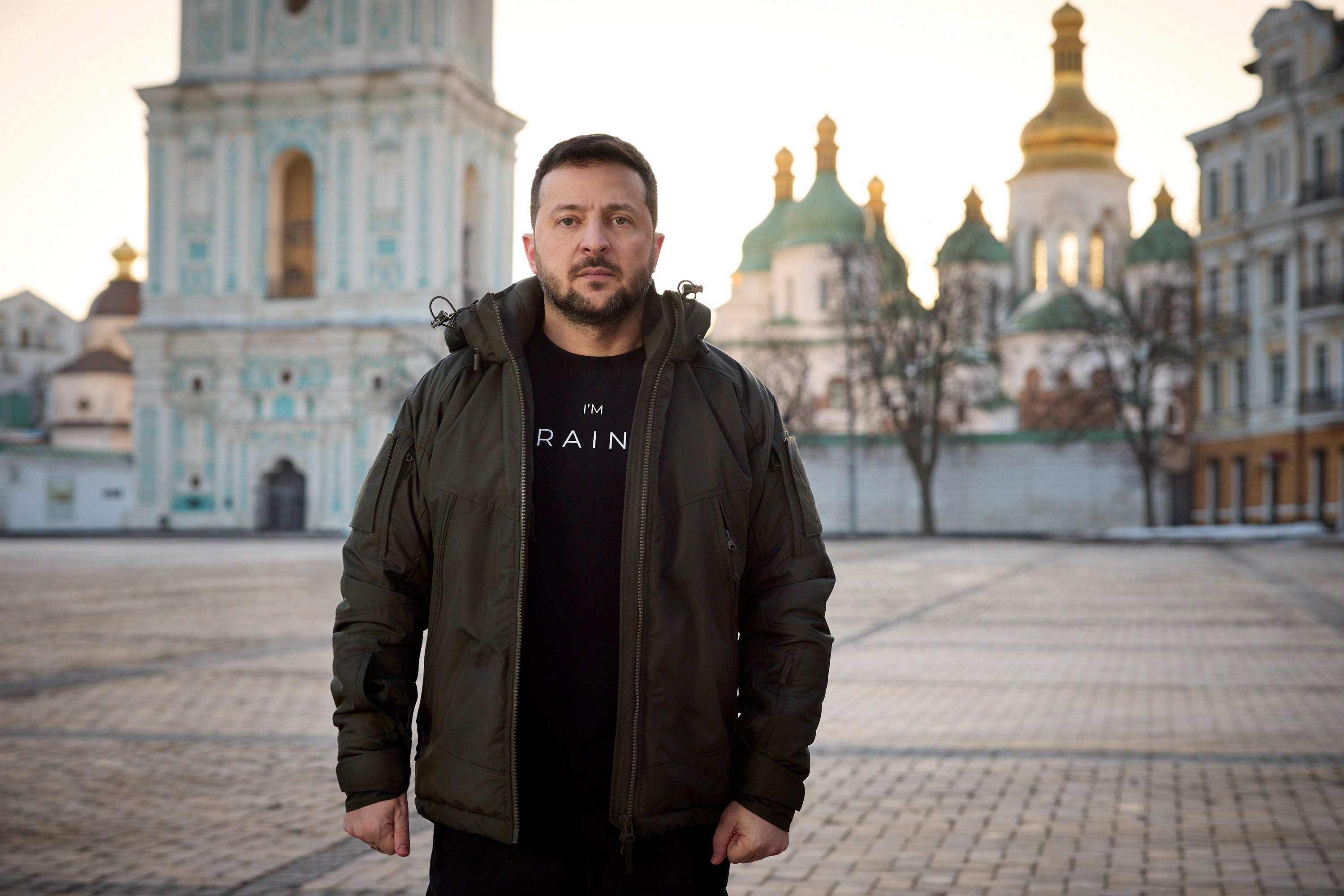
Address by the President of Ukraine, Volodymyr Zelenskyy, on the Day of Unity, January 22, 2024. Source: office of the President of Ukraine
The case seems clear: the meeting between Trump and President Zelenskyy, followed by the common meeting with certain European leaders, did not bring even the slightest breakthrough. No one could seriously have expected it: for the Europeans, it was simply a matter of limiting the damage and protecting the Ukrainian president and, in concrete terms, Ukraine itself from the worst-case scenario. This was certainly up to a certain point necessary after the disastrous meeting in Anchorage, which I will not revisit. It can be said that European leaders played the role expected of them in the current circumstances, which are nevertheless the result of the state of dependence they have brought upon themselves. However, to think that Trump has renounced his allegiance to Putin and is no longer prepared to sign an agreement on any terms would be a serious mistake. I repeat: Europeans will have to draw the necessary conclusions in the nearest possible future.
It is also clear that Europeans and Trump have a completely different understanding of Putin. The latter still imagines that Putin wants peace and will grant it to him as a special tribute—or more accurately, Trump is prepared to call any situation “peace,” even one in which Ukraine is enslaved and the massacres of the Ukrainian people continue. In fact, Trump couldn’t care less about Russia’s war crimes, crimes against humanity, and genocide. These simply don’t exist in his mental universe. It’s something that goes beyond his “understanding” in the sense that Hannah Arendt used the term, since it requires some thought. It bears repeating: the only thing that interests Trump and his sidekick Steve Witkoff is ultimately doing business with the Russian regime. Everything else is just window dressing.
Europeans know that Putin does not want peace, that he only intends to continue the war and will never stop, according to the terms used, not without reason, by Emmanuel Macron. There is also a sense that, with good reason, they do not believe in any peace agreement, although they do not say so—and it is probably a mistake not to admit this publicly. They are well aware that if there were to be anything called a “peace agreement,” it would only be a means for Putin to prepare to launch a new war, a continuation of the previous one, but even more terrible, brutal, and widespread.
But this is where we find the disturbing remnants of the cognitive dissonance that I pointed out again recently. We see them emerging in relation to the question of the Ukrainian territories occupied by Russia, where European discourse often remains riddled with intrinsic contradictions. We also see them in the worrying vagueness surrounding the “security guarantees” or supposed guarantees—this is both a question of how they are defined and of their credibility in the medium and long term. This is sometimes demonstrated by the very sequence of events that presides over this surreal diplomatic ballet, insofar as all the participants, as President Zelenskyy perfectly understands, know that they are being carried along by a movement that they do not fully control, that is largely meaningless and that, in any case, will lead nowhere.
Perhaps all democratic leaders should feel deep down the disconnect between this game of mirrors designed to distort reality and the reality itself, which is first and foremost the mass murder committed every day by Russia against the Ukrainian people. Indeed, the failure of European democratic leaders to clearly express the vital urgency of the daily situation facing Ukrainians is a sign of derailment, or at least of a shift in focus, of the entire process.
I would like to return briefly to these three points—perhaps a futile attempt to put the strategy back on track at a time when the international scene sometimes resembles a ship of fools.
Territories between law and strategy
I will not go into detail about all the reasons why no democratic government should agree to Ukrainian territories being ceded to Russia, let alone encourage Ukraine to do so. On the contrary, the goal of any democratic war must be the recovery by Kyiv of all the lands that belong to it under international law.
A first argument is, of course, the Ukrainian Constitution, which formally excludes this, as President Zelenskyy regularly reiterates. Article 2 states: “The territory of Ukraine, within its current borders, is indivisible and inviolable.” Article 157 is also perfectly clear: no amendment to the text may “abolish the independence or violate the territorial integrity of Ukraine.” As for amending the Constitution, which is the prerogative of the people under Article 5, this is impossible while the country is under martial law, which is currently the case. No state outside Ukraine can pressure the Ukrainian government to disregard constitutional law. If Trump appears to be doing so, it is only because he himself has never shown any respect for the Constitution or international law.
A second reason, which I have often pointed out, is that no one can consider these territories as if they were empty of people. They are not geographical abstractions, as some geopolitical analysts continue to regard them. The Ukrainians living under Russian occupation are subjected every day to summary executions, mass rape, torture, humiliation and, in the case of children, deportation, which constitutes a crime of genocide under the Convention of December 9, 1948, on the Prevention and Punishment of the Crime of Genocide. They are also gradually being recruited by Moscow, which not only aims to eradicate their identity, but also wants to turn them into cannon fodder to be used against their own people and, one day, against Europeans. Accepting that part of these territories remain in Russian hands would be giving Putin a license to kill, torture, rape, and deport. It would also pose a lasting threat to the security of Ukraine and the whole of Europe.
A third reason is precisely linked to this issue of security. Beyond what I have just mentioned, the Ukrainian territories occupied by Russia would constitute staging grounds for a new attack by Putin against Ukraine. He has certainly not given up on his plan to destroy or enslave the country. A freeze on the territories, even without de jure annexation, would be a sword of Damocles hanging over the heads of Ukraine and Europe—not to mention Russia’s laughable claim to part of the Donetsk region, which it has not even conquered and which contains key strategic hubs. The same applies to Crimea. Thanks to its strategic and tactical intelligence, Ukraine has succeeded in virtually ridding the Black Sea of Russian warships. Accepting that Crimea remains Russian under a pseudo-peace agreement that would, among other things, lift US sanctions, would in effect refloat Russian warships and allow the military base in Sevastopol to resume operations, once again threatening Ukraine and certain other countries bordering the Black Sea.
In this context, some European leaders and experts distinguish between legal recognition of the surrender of certain territories to Russia and de facto and provisional acceptance. It is clear that legal recognition would be a betrayal and an acceptance of annexation by force—Crimea being without precedent in Europe, outside of World War II, since the annexation of the Sudetenland by Hitler’s Germany. This would open the door to similar action by China in Taiwan or other revisionist powers. This was reiterated a few days ago by Emmanuel Macron. It would be another blow to an already weakened international law. But it is difficult to understand how it could then be decided that, in the end, Ukraine could agree, even temporarily and as part of a comprehensive agreement, without legal recognition of Moscow’s control, that territories could be ceded. Emmanuel Macron no longer mentioned the cession of territories as a realistic option, as he had done clumsily at the beginning of the year.
Nevertheless, some continue to say that it is up to Ukraine to decide whether or not to cede territory, rather than asserting, which would be more in line with our own security objectives, that such a cession of territory would be unacceptable under those objectives and under international humanitarian law and border law.
It is not the law that allows the application of law, but force. The law is there to shape reality and determine facts, not to remain a work of fiction. Ultimately, what matters is that Ukrainians in the territories under Russian control can live free, without fear of oppression, torture or death, which requires their liberation. The other fact is that Moscow has not abandoned its plan to destroy or subjugate Ukraine. The territories that would remain under its yoke would constitute a rear base from which to attack Ukraine again, and also Europe. It does not matter whether they are de jure or only de facto under Russian rule. Their control by the Kremlin would also make it more difficult, costly, and risky to implement security guarantees, given that Russia would have strengthened its military capabilities within a matter of months or years. It is time to face this reality. We do not live in a theoretical world.
Security guarantees or the great illusion
Strictly speaking, the only valid guarantee of security will come from Russia’s defeat and the expulsion of its troops from Ukrainian territory. This is a factual reality, but it is also a logical one, linked to the rule that such security guarantees must be credible. Given that the Allies have so far refused any military intervention in Ukraine, there is no reason to believe that they would be any more willing to do so in the face of a Russian army that will be stronger in a year or two than it is now. At this stage, the information that has been disclosed certainly does not reassure Ukraine, which is on the front line of Europe’s defense, nor should it reassure Europe itself.
The other problem lies further upstream. It is certainly possible and probably necessary for European military leaders to discuss what concrete plans could be implemented to put security guarantees in place. This technical conversation is certainly welcome and has already begun within the framework of the so-called “Coalition of the Willing.” However, talking today about security guarantees, except for immediate and unconditional ones that are not suspended pending a so-called peace agreement, is premature to say the least.
Indeed, the very idea of a peace agreement with Russia is fundamentally flawed from the outset. Moscow does not want peace; this has been said time and again—and by some of us well before February 24, 2022. When, these days, while some pretend to consider that such a peace agreement is possible, Russia repeats for the umpteenth time that it will never accept the deployment of EU or NATO so to say peacekeeping troops in Ukraine, it is admitting what we already know: even if there were such an agreement, Russia intends to continue the war against Ukraine and then expand it. It simply does not want Ukraine to be defended.
The reality may well be that these so-called peace talks are primarily a considerable waste of time—time that Russia intends to use to strengthen itself. While some are preparing for a false peace heralding future wars, Russia is arming itself even more for its next war. It is for this war that Europeans should be preparing much more intensively than they are today.
Returning to the content of the security guarantees, the only real issue is that of the rules of engagement for the armed forces of democracies. There will be no real security guarantees unless there is a credible resolution of these issues, regardless of their location on Ukrainian territory, which they will replicate, if necessary by targeting the depths of Russian territory, in response to missile or drone strikes against Ukraine. Everything else is just bad literature. European leaders are certainly raising a number of other points, while remaining vague on the rules of engagement: strengthening the Ukrainian army, training, increasing missile defense, etc. These actions are certainly necessary, but they are not strictly speaking security guarantees.
Ukraine has been cheated on this issue for too long. The 1994 Budapest Memorandum referred to “security assurances” (not guarantees) and did not provide for an automatic response in the event of a conventional attack. The Americans and the British exploited the absence of this clause by refusing to intervene in 2014 in a rather hypocritical manner: security assurances, even without a binding mechanism, are worthless if they are not enforced. Moreover, to date, no treaty provides for automaticity: this is also the case with Article 5 of the North Atlantic Treaty, which does not guarantee an automatic response in the event of aggression, let alone mandatory involvement by the signatory states.
I will not repeat here the shame and gross sin that was the failure of NATO member states to intervene directly after the all-out war that began on February 24, 2022. The same countries refused to establish a no-fly zone. The reality is that, rightly so, despite the growing awareness of the threat among European leaders, the Ukrainians cannot place any real trust in them. As for possible US support, this seems even more dependent on the mood of the US president, Trump or his successor, whoever that may be.
If the Allies had been serious about security guarantees, they would not have made them conditional on a peace agreement. The first time Emmanuel Macron rightly broke the taboo of sending troops on February 26, 2024, as I had been insistently suggesting for a long time, it was not conditional on any so-called peace agreement, which by definition is a sham. Even if the idea was still somewhat vague, particularly regarding the rules of engagement, the aim was clearly to secure Ukrainian territory, and in particular to prevent strikes on civilians through the presence of ground troops as a deterrent, and to thwart any further advance by Russian troops. The mistake was undoubtedly made, even independently of the somewhat laborious discussions with certain allies, including Joe Biden’s US at the time, of buying into Trump’s narrative as soon as he arrived at the White House. By making security guarantees conditional on the existence of an unlikely peace agreement, everything was done to kill the idea. From that moment on, the Europeans should have imposed their own agenda instead of letting it be determined by Washington.
At this stage, in any case, we would be deluding ourselves if we thought that the path to these security guarantees was truly credible.
A process without a destiny
It is to be feared that today, as predicted by all those who have been analyzing Russia for a long time, the entire so-called peace process is a gigantic masquerade. The reality is simple, and I wrote this two years ago, and even before that, insisting on the necessary defeat of Moscow: there can be no peace with Russia.
On the Russian side, this is obvious: Putin will continue the war to the end, regardless of the human and material cost. The war is as much a part of his power system as it is of his ideology. He will never agree to a peace deal, or if he does, he will betray it a few months or years later. A Russia that is both at peace and undefeated seems like a chimera, a griffin, or some other mythological creature.
On the European side, the attempt to promote the idea of a peace agreement, beyond the undoubtedly doomed concern to tie Trump to Europe, stems from a desire to buy time, in fact far too much time, to decide what to do—as if things were not clear enough from the outset and as if it were really necessary to sacrifice time to take the necessary decisions on massive rearmament. I would certainly not claim that Europeans are doing nothing: they have become more aware and have recognized how far behind they are. Their aid to Ukraine, although insufficient, is nevertheless continuing overall, both visibly and, presumably, invisibly.
However, it would be an insult to them to think that they believe their so-called “diplomatic” efforts will be successful. They seem to know that they are wasting time, partly because of Trump, in rather gloomy diplomatic maneuvers, but they cannot figure out how to get out of it. They stay , as is legitimate in a democracy, prisoners of part of their public opinion, without always explaining the concrete realities of the Russian threat in sufficient detail. They remain partly divided, particularly on the position to take with the US administration, including on trade and arms purchases. But they see war coming as a terrible inevitability, all the more so because they did not wage it in time, when it was certainly easier to win, with fewer sacrifices.
The reality is that Europeans are heading for disaster. I fear that they know this, but constantly repress the thought. They are ultimately governed by fear, which is the exact opposite of leadership. To acquire leadership, they would first have to accept that the lie of a possible peace agreement is precisely both a non-starter and a fallacy.
I have often expressed the idea that ultimately it will be the Ukrainians who will bring about the victory they have not seriously sought. The Europeans are ultimately relying on Ukraine, but they must be careful that these futile talks with no concrete outcome do not weaken it.
As Tacitus wrote: “Tarde venientibus ossa”—to those who arrive late, only bones remain. Let us hope that this will not be the future of the European battlefield! I wrote that the war in Ukraine, waged with a rage for extermination, was our war. Unless Russia is defeated, it will be a totally European war. The hundreds of thousands of Ukrainian victims are the result of our inconsistency and will forever be our eternal guilt. The rest of the European population could become so tomorrow. Let us not look away!