
It Would Be Inconsistent to Talk to Putin Again
What Enemy Means

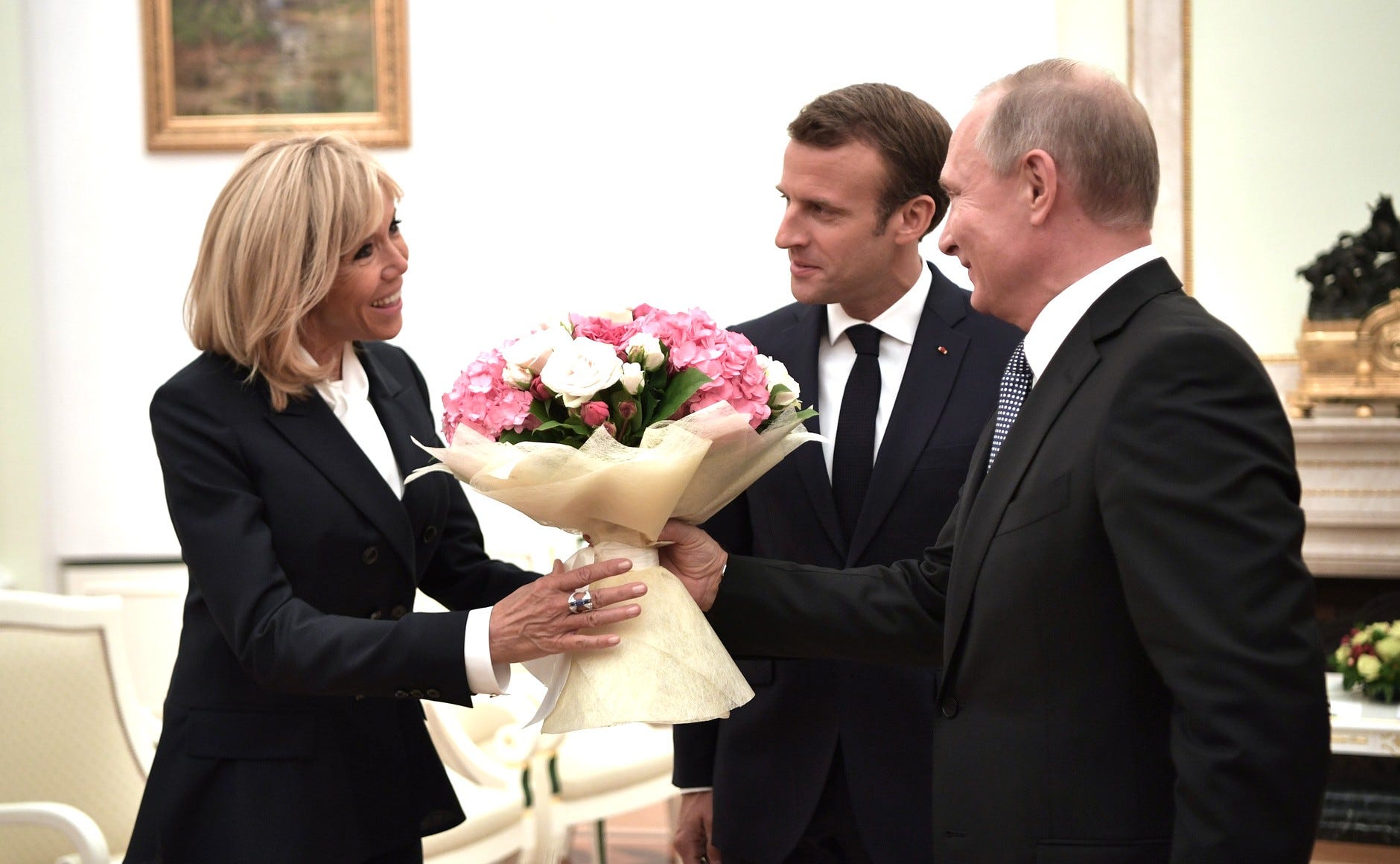
Vladimir Putin with Emmanuel Macron and his wife Brigitte Macron, Kremlin, Moscow, July 15, 2018. Source: Presidency of the Russian Federation, www.kremlin.ru. Note: this photograph will be explained in the body of the text
European chancelleries were somewhat surprised to hear French President Emmanuel Macron express the idea, following the European Council meeting on December 18 and 19, 2025, that it might be time to resume talks with Putin, so as not to let Trump have a monopoly on exchanges with the Kremlin leader, particularly, he said, if the supposed American attempts at peace fail—which will most certainly be the case. “Skepticism,” to put it mildly, seems to be the order of the day in Berlin. In reality, this temptation is not new, as the occupant of the Élysée Palace has always believed that he could make even the most hardened dictators or the most hostile minds give in, at least partially.
We remember, for example, Emmanuel Macron’s call to Vladimir Putin on July 1, 2025, the first since September 2022. It left Ukraine and its allies baffled, even though the discussion apparently focused mainly on Iran. It ended with a recognition of fundamental differences on Ukraine. While diplomatic decorum and the context of war have dissuaded many from expressing their discomfort or concern, there are silences that speak for themselves. In July, however, the French president played the transparency card and, in the wake of this, called President Zelenskyy. At the time of writing, any further calls appear to have been postponed, no doubt due to the discomfort of this position. If this were to happen, there is no doubt that the French head of state would play the transparency card. Nor is there any question that he would adopt a firm tone and that the content of the conversation would be faithfully reported to the Ukrainian president and other European allies. If it does take place, it will obviously not be a call aimed at negotiations. That is not the issue, nor is it a question of possible complicity: Macron is not Trump.
However, world events have accustomed us to so many incongruities that we end up getting used to almost everything and no longer understand the signals we are sending. This is perhaps even more true of certain heads of state and government who, at a given moment, may lose their common sense due to overwork or protection from the incessant noise of information. In certain circles, there is still a lack of people who understand not only how Russia works, but above all the cognitive biases that propaganda plays on. In reality, few are aware of its pitfalls.
Perhaps because I have been observing it for too long, well before the start of the Russian war against Ukraine in 2014, certain speeches have the power to alert me immediately. So when a friend, a French general, told me about the July 2025 appeal