
What Is Artificial Intelligence?
Global Challenges Shaping the Coming Decades


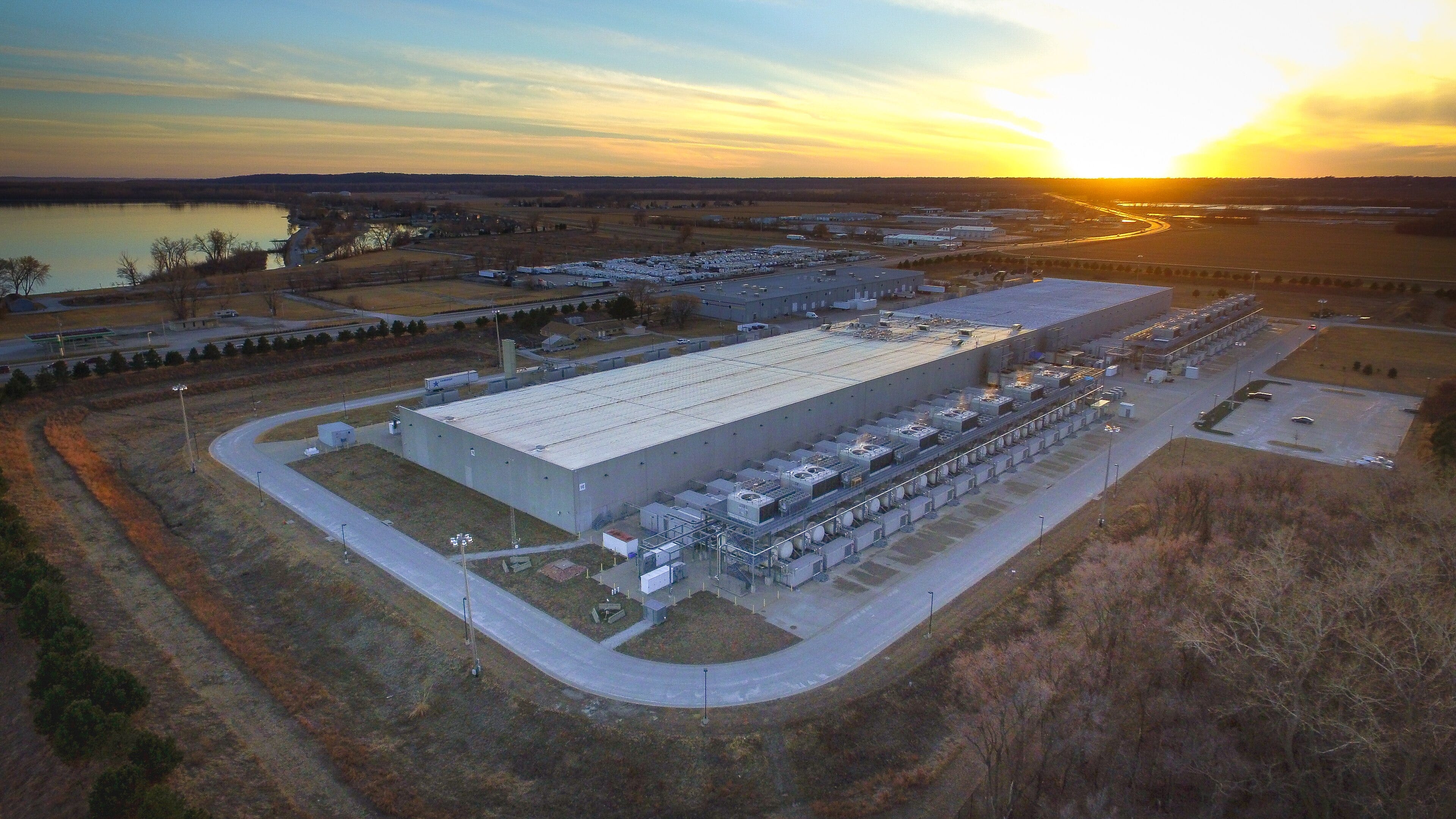
Aerial view of the Google Data Center in Council Bluffs, Iowa, USA, February 17, 2018. Source: Google Data Center, Council Bluffs Iowa. Author: chaddavis.photography
This article is the first in a series of six essays on artificial intelligence. It provides basic definitions of the subject we will be discussing and describes the new AI economy. Understanding this landscape is essential to grasping the sovereignty and security issues discussed below.
This series of essays was written with Constantin Vaillant Tenzer, a researcher in mathematics applied to cognitive neuroscience and machine learning at the École normale supérieure Ulm (Paris Sciences et Lettres University). For more than four years, he has been working on improving training methods for artificial intelligence algorithms, in collaboration with French and American companies.
Since ChatGPT was launched for the general public on November 30, 2022, artificial intelligence tools for the general public have continued to develop. They have become ubiquitous in public debate, well beyond specialized circles. Before speculating on the future of these technologies, their current and potential functions, their risks and strategic uses, it is necessary to define them and clarify how they work and their place in the contemporary digital economy.
Artificial intelligence can be defined as the implementation of algorithms capable of performing tasks that, until now, required human cognitive abilities: perception, classification, translation, writing, decision-making—sometimes seeking to imitate or even surpass human capabilities. Early historical examples include the fairground automatons that appeared in the 18th century, automatic chess robots, video game AI, and chatbots—automated conversational bots—that ask multiple-choice questions. However, these early algorithms were all based on decision trees or sometimes more complex criteria, based on explicit programming. This is the main difference with what is known as machine learning: the programming of algorithms that must produce another algorithm, commonly referred to as a “model,” after a process called “training.”
The revolution of machine learning and deep learning
In practice, machine learning consists in adjusting a large number of parameters to optimize an objective function (for example, the probability of correctly classifying an image or a sentence). There are methods that allow the algorithm, during its use, to learn from its mistakes, either by itself, by observing the result of its interaction with the world, or from feedback provided by human users. All the machine learning algorithms are based on powerful statistics, probabilities and linear algebra theorems. The fact that those algorithms are not deterministic—they won’t give exactly the same output in the same situation—makes them adaptable to different contexts, hence so powerful and useful. Therefore, the capacity to do things that are not expected is a feature of those algorithm. Deviations can be controlled automatically. But often errors appearing on commercialized models happen ether because of an issue in the training process (over-fitting, too similar test dataset, etc.) or because the training data were not adapted to the task the model is effectively used for—causing the model to invent something random, since it is programmed to give an answer.
A subcategory of machine learning algorithms, which enable continuous learning and often much better performance, are deep learning algorithms. Deep learning is a subcategory of machine learning that uses deep neural networks, based on the Perceptron architecture (1957). However, it was not possible to technically extend such machines at the time, before the training of convulational neural networks (CNN) in the late 1980s, using back-propagation—marking the end of what is called the AI winter. According to one of its creators, Yann Le Cun, deep learning “is constructing networks of parameterized functional modules and training them from examples using gradient-based optimization.” Deep neural networks can be understood as a series of simple learning algorithms that interact with each other to produce a result that improves via an intelligent system of chained error corrections. While deep learning makes it possible to obtain much more robust and powerful models, this comes at the expense of interpretability: the presence of intermediate layers of neurons creates a black box phenomenon, which makes it impossible to explain the algorithm’s output.
These algorithms require costly vectors and matrices calculations that are poorly suited to conventional processors (central processing units, or CPUs), but are very effective when using graphics processing units (GPUs), which were originally designed for image rendering and are used by graphic designers and video game enthusiasts.
The widespread use of GPUs for deep learning has been an economic and geostrategic turning point: running state of the art AI models now depends almost directly on access to thousands, then hundreds of thousands, of state-of-the-art GPUs. This hardware dependency will be at the heart of the discussion on sovereignty in our second article. The significant economic, environmental, and geostrategic issues surrounding GPUs will be the subject of an entire section. About 20 millions GPUs were sold in the last quarter of 2025.
AI models
AI models can be classified into three main categories of use.
The first category includes models for classification purposes—for example, optical character recognition, cancer cell recognition in medical imaging, facial recognition, text translation models (popular in the early 2020s), traditional web search, and personalized recommendation systems, which are central to the functioning of social networks (Facebook, Instagram, X, TikTok, etc.) or video platforms such as YouTube. These algorithms both build user loyalty by offering content most likely to keep them online and generate maximum advertising revenue for advertisers. Most of them are based on deep learning algorithms.
A second category is what is known as generative AI (genAI), the most famous models of which are those developed by OpenAI: ChatGPT for text generation, Dall-e for image generation, and Sora for video generation. Other examples include Claude (Anthropic), Grok (X-AI), Gemini (Google), and Meta-AI for LLMs, as well as Midjourney and Stable Diffusion for image generation. The most recent image, sound, and video models are also called “diffusion models” because they are capable of processing text, sound, and images in a single stream. These large language models (LLMs) and diffusion models are based on the transformer architecture, invented in 2017, which are trained using deep learning methods.
The third type of model, which still has great potential for development, is robotics models. Unlike “traditional” robots, from which they should be distinguished, these systems can adapt their behavior based on experiential data rather than following a fixed script. Their uses are much less developed than the previous two types. However, recent models used on combat drones in Ukraine, a few robots in logistics platforms, certain industrial robots, and others used for military site surveillance come to mind.
Finally, these models may have the ability to use other services, such as performing web searches, producing and executing computer code, reading files, interacting with web pages, or remote communication protocols. These are known as “agents.” Generative models with these capabilities perform best on the most difficult performance tests, such as Humanity Last Exam.
Another dichotomy is between proprietary models and open source models. Companies that manufacture the former provide minimal information about how they work, the sources of training data, the exact architecture (including the number of parameters, which makes it possible to assess the economic and energy impact of using the model), security mechanisms, etc.
They allow users to use the models, either through a web or mobile application, often on a freemium model: access to the simplest versions of the models is free, with usage limits for more advanced versions. Access to more advanced features on the application requires a subscription (with enterprise and individual versions) costing a few dozen dollars per month.
Access to state-of-the-art features requires a subscription of a few hundred euros per month. They also offer the use of their models, for example to integrate them into third-party applications, via APIs (Application Programming Interface: a facade through which one piece of software offers services to another piece of software—in this case, between a user who sends a prompt to a server, possibly with other information, such as an authentication key, which returns the AI model’s response), with pay-per-use (corresponding to the number of tokens sent and received—the token being the semantic unit of LLMs; in English a token corresponds on average to three-quarters of a word).
Open source models are available for download, most often via the Franco-American platform HuggingFace—a key player in the sector founded in 2016—whose platform exceeded one billion annual requests in 2024. This means that anyone with sufficient computational resources can use the model from their own servers, modify it, improve it, prune it, fine-tune it, etc. It is also possible to use it as an API via HuggingFace and often also through the model’s creators—often at a much lower cost than proprietary models. For example, ChatGPT 5.2 costs $14 per million tokens issued and $1.4 per million tokens input, while the latest version of DeepSeek costs $0.42 per million tokens output and $0.26 per million tokens input.
However, open source does not guarantee total transparency, particularly with regard to data, processes, and training algorithms, nor does it guarantee the absence of risks of abuse or misuse. Sites such as https://llm-stats.com/—a site that allows users to compare the performance of different LLMs on different benchmarks in real time and see their prices—offer regular rankings.
The latest ranking clearly shows that American companies (OpenAI, Google, Anthropic, X-AI) produce the highest quality proprietary models, while Chinese companies (DeepSeek, AliBaba, MoonShot, ZnipuAI etc.) produce the most powerful open source models. The first model from another country, Mistral Large 3, developed by the French company Mistral, only ranks 55th as of March 14th, 2026, in the coding tests (and 36th as a Q&A chat bot, where it is the best). Another interesting comparison is that of LMSYS, based on user reviews. Comparisons offered on this site show the same results, with American proprietary models well ahead of Chinese open source models. However, benchmarks should be taken with a grain of salt: there is a risk that some designers may deliberately overfit these benchmarks, often at the expense of real performance.
The challenges of using models
A key characteristic of a model is its number of parameters. This corresponds to the number of free variables adjusted during model training.
With the same training process, the more parameters a model has, the better it performs, but the longer it takes to train and the more computational resources it requires, as does its use while prompted. As an indication, the most powerful image classification models (ResNET, MobileNet by Google, for example, for tasks on ImageNet, the reference dataset) today have tens of millions of parameters.
These models can be trained on a good laptop used by graphic designers or video game enthusiasts, requiring a few dozen watts of power (the power of a low-energy incandescent light bulb).
Large language models—a category that includes most generative AI models—have several billion parameters for highly specialized models, which can run on a server the size of a large broom closet with power consumption equivalent to the average household. Generalist models such as Gemini, Grok, GPT, and Claude have several hundred, or even nearly a thousand billion parameters. Running them at home for personal use, with the same quality of service as a high-end professional subscription, would require a dedicated room for servers and cooling, and electricity consumption comparable to several dozen households.
This is one of the reasons why, for confidential use, such as for the services of a high-tech SME, it is preferable to work with OpenSource models (Nemotron by Nvidia, Qwen by Alibaba, DeepSeek, Kimi by MoonshotAI, etc.) that are significantly smaller in size (around 30 billion parameters). Practice shows that a small, well-chosen model often achieves much better results than generalist models, after the data sent to the model has been properly processed (RAG, system agentization, and prompt engineering). It is often unnecessary to distill or fine-tune them for specific tasks or domains, given the material and human cost of such an operation and the very rapid improvement of these small models by their producers. However, this type of operation can be useful for intermediate natural language processing (NLP) models with less than a billion parameters in the data processing chain (for instance BERT-like models).
Producers of artificial intelligence models
Until the end of 2022, artificial intelligence was mainly a field of research. The vast majority of models and algorithms were public, and their use for economic purposes was limited to very specific use cases:
- management and use of internet user data for advertising and content recommendations—derivatives of these algorithms are still essential components of products and companies such as YouTube, Google Ads, Facebook, Instagram, and Criteo. They are based on advanced statistical analysis of massive amounts of usage data. The models were designed to be inexpensive, fast, and close to optimal for specialized tasks;
- analysis of satellite images for military or economic intelligence on behalf of banks and investment funds;
- trading algorithms;
- automatic analysis of medical imaging;
- text translation;
- experimental uses by government or military intelligence services, such as the automatic analysis of large amounts of voice and text data collected by services such as the NSA for the purpose of detecting potential terrorist attacks, or the use of exoskeletons in the military and, more generally, experiments with augmented soldiers.
This use is evolving even more significantly in China, which serves as a testing ground for social experimentation. Nevertheless, even in the sectors concerned, with the exception of the first case due to the quantities of data processed, the use of machine learning was not frequent, and companies developed their algorithms either for strictly internal use or to sell them to professionals in cutting-edge sectors. The development of autonomous robotics had not led to any widespread commercial use, as evidenced by the numerous changes in ownership of Boston Dynamics—famous for its YouTube videos of robots and currently one of the most advanced company in the field.
Since ChatGPT was made available to the general public, things have changed significantly. The American company will have raised nearly $60 billion and will likely have spent $100 billion by 2029. According to the American firm Gartner, global AI spending is estimated at $1.5 trillion in 2025, or 1.5% of global GDP. Microsoft owns 51% of the AI giant and is recouping its investment through its cloud services. Google is trying to follow the same business model, with less success. At the time of writing, Anthropic, with Claude Opus 4.6, offers the most powerful agentic language model. But performance often varies, and sometimes it is the Gemini, Claude, or GPT models that top the rankings. Meta (Llama), AliBaba (Qwen), Xiaomi, ZnipuAI (GLM) and Baidu (Ernie) have also entered the race for large language models without making any financial profit, choosing to share their models as open source. Other companies have been developed specifically to create generative AI models: X-AI (Grok) in the US, DeepSeek and MoonShotAI (Kimi) in China, and Mistral in France.
None of these companies are currently making a profit. For the giants, the goal is to produce the best models in order to gain the maximum number of dependent users, in line with the well-known logic of tech: “the winner takes all,” at the cost of hundreds of billions in investment. The exploitation of proprietary LLMs generates no profit for anyone, whether for the giants, for whom their historical sources of income (sponsored search for Google, advertising for Meta, software sales for Microsoft) are still largely predominant, or for large specialized startups. But the cloud is generating growing revenues (+34% for Google Cloud and Microsoft Azure, which also serve the main AI models for internal corporate use, +19% for AWS).
Smaller players, such as Mistral, know that due to their relatively low financial capacity, they will probably not be able to compete with the bigger players in terms of performance and marketing, and are deciding to develop services for businesses, enabling them to obtain stable long-term revenues and easily predictable profits that reassure investors.
The economic ecosystem of generative AI. A financial bubble?
In this AI economy, beyond the big players, it is important to consider the chain as a whole. Around these producers of foundation models, an entire economy is emerging.
On the downstream side, there are those who use these models, possibly modifying them if they are open source, to improve and specialize them. There are those, such as Perplexity, Character.ai, and dozens of sector-specific startups (health, finance, HR, legal) that build services on these models via APIs, combining prompt engineering, external tools, and proprietary data.
The techniques used for these services often involve prompt engineering: the difficult art of writing instructions that are not too long (to limit costs) but sufficiently comprehensive and clear to obtain the desired result from the model. These services can be, like Perplexity, aimed at a broad audience (B2C) or designed to meet the specific needs of businesses (B2B). Companies seek to capture as many users and developers as possible who are dependent on their ecosystem, at the cost of massive financial losses over several years.
Finally, there are direct users (via a platform clearly identified as AI) or indirect users, who consume AI, sometimes without knowing it—the majority of articles available on the internet are written by AI. These users may use AI for personal or sometimes professional purposes, potentially sending economically sensitive data to unknown destinations.
Upstream, there are the producers of specialized chips: those who design and market the chip, such as Nvidia, Google, ARM, Intel, etc., those who manufacture the essential and costly machines used to make the chips, such as the Dutch company ASML, those, often Chinese, Taiwanese, or Korean, who manufacture the chips (Foxconn, TSMC, SK Hynix), and those of the same nationalities who extract the precious materials used in their manufacture (notably OCI, GCL-Poly, CNRE, CMOC). There are also those who assemble graphics processors into servers that can be used by businesses: Oracle, Amazon Web Service, Google Cloud, Microsoft, and to a lesser extent, France’s Scaleway and other long-standing cloud providers such as OVH or Arum technologies, which are gradually beginning to serve AI.
So, can we talk about an AI bubble? The best comparison would be with the internet bubble of the early 2000s. Like the internet, AI will continue to be widely used in the future, and its material and energy costs will fall considerably in the coming years, while its performance will increase tenfold. Companies that were well established before AI (Microsoft, Nvidia, Google, Meta, Amazon, Oracle) and are already diversified may be overvalued on the stock market, but any decline will likely be quickly offset, as AI is not their core business or their AI-related assets are unlikely to fall thanks to a billing and investment strategy that gives them financial security. Many AI-focused startups or “unicorns,” on the other hand, could disappear or be absorbed, lacking a profitable business model once the stock market euphoria subsides. These are the ones, large and small, that will not have been able to make themselves indispensable before the bubble bursts, like many startups—some of which had already reached the IPO (initial public offering) stage—before the internet bubble. Others that will suffer a major setback are established companies that have invested heavily in AI, but ineffectively, and have consequently been overvalued.
The issue is nevertheless more difficult for large independent American AI players such as OpenAI: although they have a large number of paying customers via API or subscription, they remain heavily in deficit (estimated annual losses of $30 billion by 2025) and are supported, in part, by circular investments linked to purchases of Nvidia GPUs. The company expects to be profitable by 2030. But it is also possible that the world leader in generative AI will have to learn restraint and diversification in order to be profitable.
Chinese players will have access to a market of several billion consumers. China could soon become the leading AI economy—not counting subcontracting for Western companies—with much lower investments than its American competitors and a fully sovereign economy. Through the massive collection of data from the private lives of its citizens, China also has a training dataset that is unique in the world and of great financial value. It is therefore highly likely that they will not suffer from the AI bubble and will eventually be able to acquire a form of dominance. Finally, if Europeans succeed in building an artificial intelligence economy, it is very likely that, being smaller, it will be mainly supported by their customers rather than massive investments and will therefore not be severely affected by the possible bursting of a financial bubble. However, customers must prefer them to their more visible and commercially aggressive American and Chinese competitors.
The generative AI revolution is not only a major technological advance, but also a revolution for the global economy with essential geostrategic implications.
This therefore raises political questions, particularly regarding the hardware required for AI, which accounts for nearly 95% of its cost. In the next article, we will therefore discuss the issues related to GPU manufacturing (a monopoly of the American company Nvidia), issues surrounding rare earths and semiconductors, ecological impact, etc. You will also understand the reason behind the figures you have just read. The risk is the unilateral imposition of rules by the United States and China to the detriment of democracies.