
Ukraine: The Case For Optimism
Where Realism and Rationality Meet

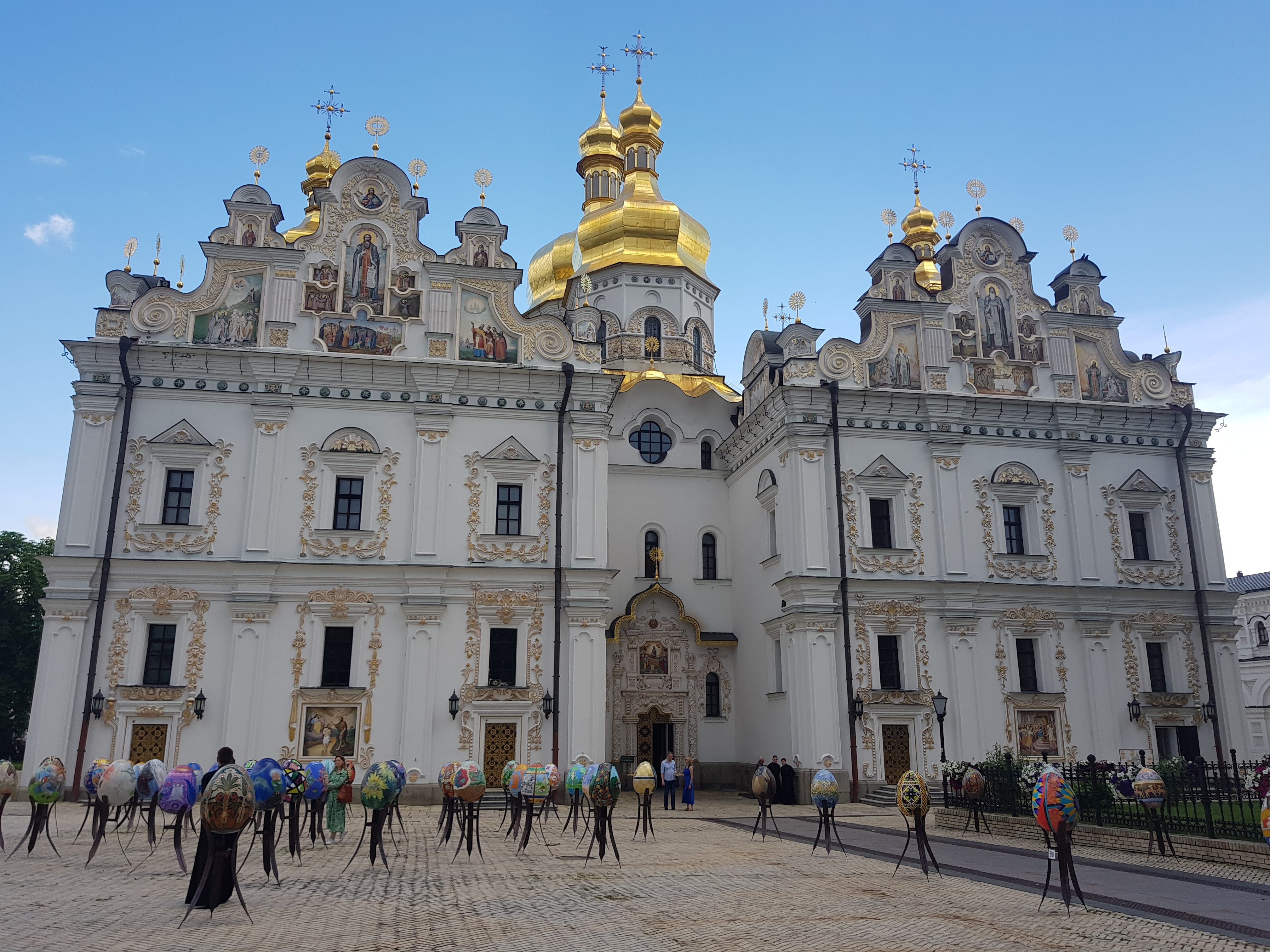
Kyiv Pechersk Lavra, Ukraine, June 2, 2024. Photo: Nicolas Tenzer
It is not without a certain tremor in my fingers that I write the word “optimism” when talking about Ukraine’s future. I hope my Ukrainian friends will not hold it against me for using it, given that their daily lives are marked by the killing of civilians by Russian forces, endless torture, the ongoing deportation of children, and incessant destruction. How can we forget the Ukrainian soldiers who are fighting tooth and nail against the Russian enemy in appalling conditions—but who, overall, are holding their ground? How can we talk about optimism when death is everywhere and, in Ukraine, can strike anyone, in their sleep or in broad daylight?
At a recent conference in Germany at which I was speaking, some of my colleagues preferred to use the word “hope.” On reflection, I find it insufficiently strong and, above all, it seems to me to be based on a feeling of improbable transcendence—it takes on a religious dimension that is quite foreign to me. The argument I prefer to develop in favor of optimism seems to me to be based both on the rationality of facts and, ultimately, on what can be called, particularly in the field of international relations, realism. These are the two terms that need to be combined.
Of course, many people often ask me, “Are you pessimistic or optimistic?” I generally decline to answer and prefer to say that I refuse to get involved in such considerations.
All of us who have been warning Western political leaders for more than a decade about the Russian threat and who see that a war is being fought in Ukraine, the outcome of which will determine the coming decades, find it difficult to shake off the fear that the absolute evil embodied by Russia will prevail. We also perceive the backtracking of some Westerners, their persistent failure to understand what is really at stake, or, at the very least, their refusal to act accordingly when they do understand. Put mildly, we see their resolve as insufficient. However, a serious analyst of international relations has no right to give in to fear and cannot think, because it would not be rational, that previous trends will continue unchanged. To think in terms of fatalism is not to think at all.
Conversely, there are forms of optimism that are based solely on wishful thinking. Those who profess it do not always seek to base it on reason and cling to a few tenuous signs. They are convinced that evil cannot triumph, when in reality it always remains a possibility. I certainly cannot blame these optimists, especially if, in the depths of a damp and freezing prison or in the midst of gunfire, they draw on it to find the strength to live, if not to survive and resist torture, and to fight with the most vital of energies.
But for those who remain outside this struggle, there is a high risk that both pessimism and optimism will remain either fatalistic or a belief borrowed from the theory of predestination. Both detract from intelligent action.
But well-founded optimism makes it possible to break with this strategic failure. It allows us to build a strategy based precisely on factual data that enables us to make the most of the balance of power—and thus to win. This is what the Ukrainians are doing today.
A war that the Ukrainians will win
Without even mentioning the childish boasting of the Kremlin criminals who imagined they could take Kyiv in three days, we remember the dire predictions of certain self-proclaimed experts. During the first year of Russia’s war against Ukraine, they announced, repeating it ever since and continuing to do so today, that it was impossible for Ukraine to win. They pointed to Russia’s demographics, with a population three times larger than Ukraine’s, the size of its army and its reserves of manpower, Russia’s GDP, which, although low, was still higher than Ukraine’s, and, of course, the massive massive aid provided by Iran at the start of the war, as well as by North Korea and China. However, a poor strategist and connoisseur of war is someone who relies on simple arithmetic to assess the balance of power.
We could discuss at length the distinction made by Blaise Pascal (1623-1662) between the spirit of geometry and the spirit of finesse, which the mathematician, theologian, and philosopher said was a “grace” when combined. Of course, Russian propaganda mouthpieces have done nothing but repeat this defeatist thesis, which is in fact based on a miscalculation by a surveyor: the false scholars had prepared the ground.
Almost ten years ago, an expert in electoral analysis noted that one of the most reliable predictors of a candidate’s or party’s results was the momentum they had generated, whereas stagnation in voters’ perceptions was, on the contrary, often a harbinger of defeat, even if the candidate appeared to have a comfortable lead. With all the usual caveats, this analysis can be broadly transposed to the battlefield.
We know that Russian forces are making little or no progress, and every square meter they conquer, often only to lose it again, results in huge losses that Putin and the Russian command do not care about. Perhaps they have learned some lessons from their initial mistakes, but their command is too worn out for this to translate into major successes. On the other hand, the Ukrainians have been, as we see almost every day, at the forefront not only of technological innovation with drones and marine drones, and tomorrow with long-range missiles, but also of ingenuity in military intelligence. They will certainly need even more resources to secure a complete victory over the Russian army and force it to leave the territory it occupies, but Kyiv has already scored decisive blows that are weakening the Russian economy and army.
There is every reason to believe that, with a little more European aid—which is still very insufficient, despite considerable efforts by countries such as Norway, Germany, the Nordic EU countries, and the Baltic states in particular—the beginning of the reconquest can be accelerated. In reality, Ukraine will not need to militarily recapture every area occupied by the Russian invader inch by inch. It will suffice to deal decisive blows to certain enemy military infrastructures, particularly ammunition depots, missile launchers and combat aircraft, or even command centers and logistics facilities such as fuel depots and refineries, so that Moscow will not only be unable to advance, but will also be forced to withdraw from certain positions due to a lack of ammunition, manpower, and logistical support.
Therefore, a consistent geometric approach must not stop at the raw balance of power, the population, and the actual shell and missile production capabilities of the Russian war machine, but must also take into account the “geometry” on the Ukrainian side, which is in the process of surpassing Russia in terms of technological capabilities. To do justice to geometry is also to identify how the Ukrainians choose their targets and organize both their defense and attack plans. Adding finesse to this means understanding how they deploy their own cunning, a combination of acuity, caution, and situational intelligence—ultimately, a set of qualities that the ancient Greeks summed up in one word: mètis (μῆτις). This is certainly produced by unique individuals who pool their intellectual resources. It thus becomes the defining attribute of Ukraine as a nation at war—a set of outstanding qualities that Russia will never be able to possess.
So yes, undoubtedly, Ukraine has not yet won the war, and by definition, there is an unpredictability in its course that defies logic, morality, and rationality. The situation on the battlefield is not only unspeakably horrific for Ukrainian forces, but it also remains precarious. How many thousands more of these noble souls will die, not because of their own failings, but because of the West’s pusillanimity, its irresoluteness, its all too rare intelligence—its ultimately “half-skilled” character, to borrow another expression from Pascal, which was not the most flattering—and sometimes its own turpitude? But the momentum is on Ukraine’s side. Its victory will still take time, too much time, again because of the cowardice of the Western camp, but it is inevitable. Rationality in the conduct of the fight is on its side, along with intelligence. But it is now up to democracies to understand that this is the only realistic path.
The power of a nation
Among the achievements of the Ukrainian Resistance and its war against a genocidal aggressor, we often cite the fact that Ukraine has earned, once and for all, its recognition as a nation. Ukraine is a nation that, whatever the outcome, will be greater, stronger, and more dignified than Russia for all eternity. Russia will forever remain, in history, a miserable country marked by mass crime, servility, infamy, and indignity. Ukraine will live on, no matter what happens, while Russia will sink into oblivion as a country whose existence can never be justified. In any case, within a few decades, it will disappear as a great country, not only morally and spiritually, but also physically. On December 26, 2025, we celebrated the 34th anniversary of the demise of the Soviet Union. There will be other December 26ths that will mark the end of the Russian pseudo-empire as it exists today. It is not certain that Russia will be defeated militarily—even if our duty is indeed to defeat it militarily in Ukraine—but it will ultimately have worked methodically toward its own fall.
Admittedly, this historic emergence of the Ukrainian nation as an “indispensable” and even irreplaceable nation has been perceived abroad thanks to the incredible actions of the Ukrainian Resistance. Those in Europe and elsewhere who were unaware of it have now discovered it. Domestically, too, beyond the political discord inherent in any democracy, Ukrainians have further strengthened their sense of belonging to a single nation, regardless of their region of origin, religion, or language. But other events had already contributed to this: the referendum on Ukraine’s independence on December 1, 1991, bore witness to this, as did the Orange Revolution and then the Revolution of Dignity in Maidan. But it would be wrong to think that this national sentiment did not already exist: even beyond the Holodomor, the Soviet yoke had already made Ukrainians understand that national independence meant freedom. I have already, in these pages, paid tribute to Alla Horska, who was assassinated by the NKVD in 1970 and who championed this cause. There were many other figures who took part in this struggle at the risk of their lives.
The West is gradually discovering that Ukraine has a history, that there is a Ukrainian history independent of that of Russia and the Soviet Union, but also of other peoples who have passed through this land of passage that is Ukraine. But Ukraine’s strength lies precisely in not excluding any of them, but in bringing them together. What makes Ukraine united is precisely its diversity and plurality. Ukraine’s national struggle is a struggle for a political nation, not an ethnic nation closed in on itself. Russia’s struggle is exclusive, ethnic, based on hatred and contempt for the other. Ukraine’s struggle is universal in scope.
It is also for this reason that when it is said that Ukraine is on the front line in the defense of Europe, this is certainly true militarily and strategically. Ukraine is now the shield, and young Ukrainians are fighting and often dying for Europeans. They are waging the war that has been waged on us and that we have not had the intelligence and courage to wage ourselves. But Ukraine is also the spearhead in the defense of our principles and values. When Ukrainians, since Maidan, assert that their struggle is driven by a certain idea of Europe that many among the member peoples of the European Union no longer even perceive, this also and above all means that they are more European than many citizens of Europe. Ukraine is a European nation in its own right, through its history, its conception of its people, what it stands for, and certainly through its courage—but also through its perfect symmetry in opposing the enemy that seeks to destroy it.
Of course, some will argue that Ukraine does not yet “tick all the boxes,” that the effort to meet standards—the acquis—will still take a long time, that corruption remains too high, despite the immense progress made over the last ten years, and that there are still differences in the “European consciousness” of Ukrainians. That may be true, but it does not negate the European identity of the Ukrainian nation and people. And who are we, as Europeans and members of the European Union, to lecture them? What have we actually done to oppose the radical enemy that Ukraine is fighting? Did we have the courage, even before the war, of the Maidan fighters? Is our European consciousness so strong when certain European nations have already given, and could still give in the future, power and, previously, votes to political parties, then to governments, that are hostile to the very principles of Europe and, in some cases, cozy with the Russian enemy? The far right in Ukraine accounts for about 1% of the vote. This must always be remembered.
Of course, being a nation does not necessarily and logically imply victory. Even exemplary nations can fall. There is no law of history that says good always triumphs over darkness. Many Western European countries have too easily internalized this belief since the defeat of Nazi Germany in 1945. Historians know that there is no determinism that prescribes the victory of dignity, law, and decency. There are many perfectly credible counterfactual historical scenarios in which Nazi Germany could have won—especially if Hitler had not attacked his Soviet ally. A Soviet-Nazi condominium, as seemed to be taking shape between 1939 and 1941, could have existed. Many of us would not be here to discuss it.
So Ukraine’s victory is not a foregone conclusion and will be due first and foremost to the intelligence and courage of its fighters and the entire Ukrainian population. But the fact that there is a self-aware Ukrainian nation, fighting as a nation unlike a so-called Russian nation whose totalitarian power prevents even national existence, gives it unparalleled strength. Even if, unfortunately, due to the cowardice of certain Western countries, part of Ukrainian territory were to remain under Russian control for some time, the Ukrainian nation would not give up its struggle and would eventually reclaim it. A free nation has resources that a totalitarian state will never have.
Ukraine and its “friends”
I will not dwell now on the latest episodes of pseudo-negotiations, in which we saw Trump and his advisors persisting in a mixture of grotesqueness and infamy, siding with the criminal Russian state and demonstrating their total indifference to the victims as well as their contempt for international law. As Ukrainian-born activist and writer Inna Shevchenko recently wrote: “Trump doesn’t care how this war ends. If it ends with Ukraine erased and Russia victorious, he’s fine with it. He’ll just point at the ruins and say: look, it’s going to be amazing.” There is no more accurate and precise definition of amorality.
I often imagine what President Zelenskyy’s thoughts might be—and I know firsthand those of many Ukrainian friends. They know they can never trust the United States again—and that was already true under Joe Biden. They know that Trump is going even further, since he has switched sides to the enemy. For some in the current US administration, this is part of a carefully thought-out ideological project: allying with Russia is not the result of chance, but signals a complete ideological alignment. For some MAGA “thinkers,” Russia has become a means of fighting against freedom, law, and dignity, all things they hate more than anything else.
I am also not sure that they consider certain European “allies” to be true friends, despite President Zelenskyy’s polite statements to that effect. They also know that they will not go all the way in their support, that they do not have a complete understanding, despite their proclamations, of the nature of the Russian threat, and that they are not ultimately prepared to fight, because that is the ultimate truth that would prove their alliance, to prevent Ukraine from being amputated of part of its territory. They also know what the repeated and almost automatically softened statements about a “just and lasting peace” mean when they utter them, that is, without any real thought behind them. Perhaps some states and governments are exceptions to this reality, but this is not the case for most. Admittedly, they do not have the same hostility towards Ukraine as Trump, and they are more aware of the mortal danger that Moscow poses to Europe. But a real alliance cannot be measured in terms of a few hundred million or even a few billion dollars’ worth of weapons delivered, let alone commitments for the future. A real alliance is measured in the present.
Let’s be straightforward: the fact that Ukraine was granted a €90 billion loan by the last European Council on December 18 and 19, 2025, is reassuring news. But the fact that the European Union was unable to agree on seizing frozen Russian assets, even if they are blocked indefinitely, speaks volumes about the concern of some to still spare Russia. Or to put it another way, they are not planning for Moscow’s total defeat.
Ukraine knows this, from the foot soldier in a unit on the front line who is desperately short of shells or protection against enemy drones, to the artilleryman who has not been given long-range missiles, to the ordinary civilian who knows that the Europeans have not closed Ukrainian skies, even though they could easily have done so, and the Ukrainian president and ministers.
So Ukraine knows that, at the end of the day, it is alone. It does not proclaim this; it refrains from saying it, like an intimate pain that one does not even share with one’s loved ones; but it knows it. It knows where it comes from, measures its implications, and assesses its consequences. It has been perfectly aware of this since almost the beginning of the war—since 2014, since 2022, and still today. But it is organizing itself accordingly. It would certainly like more weapons and does not hold back, rightly so, from asking for them; but it does not rely on them for its own victory. It has already devised plans for that. And it is perhaps because, ultimately, it has given itself the means to decide everything that it will have acquired the ability to win.
On this last day of the year, I wish my subscribers and readers a wonderful and fulfilling year, full of joy, discoveries, and achievements.
Today, my thoughts are particularly with the Ukrainian fighters who are giving their lives for freedom and the Ukrainian people who support them.
Beyond this special tribute, I extend my wishes for victory to all those, in all corners of the world, who dare to stand up against tyrannical powers. Their fight is our fight.
Happy New Year 2026!